


Views: 0 Author: Site Editor Publish Time: 2026-11-06 Origin: Site


Table of Contents
Salmon DNA holds the key to profound skin transformation. The global skincare industry is currently experiencing a massive paradigm shift toward regenerative, clinical-grade formulations. At the absolute forefront of this movement is Polydeoxyribonucleotide, widely known as PDRN. This biological active derived from salmon DNA is aggressively dominating global beauty trends and clinical dermatology.
Recent market data reveals a sharp pivot in consumer behavior. The demand for non-invasive aesthetic alternatives is surging at an unprecedented rate. Shoppers now expect medical-grade efficacy at home. They demand rapid tissue repair and intense collagen synthesis without the downtime or steep costs of clinic visits. This transition from professional injectables to daily topical solutions creates a highly lucrative window for independent beauty entrepreneurs.
However, a significant technical hurdle exists for emerging beauty brands, estheticians, and medical spa owners. Formulating complex biological ingredients from scratch is an exceptionally expensive, high-risk, and time-consuming endeavor. Rigorous stability testing and research can drain capital before a single bottle is ever sold.
Fortunately, creating a private label PDRN skincare line offers a highly strategic solution. By partnering with an established contract manufacturer, you can completely bypass the heavy burdens of independent formulation and facility management. This comprehensive guide details the exact methodologies required to build, formulate, package, and successfully launch a premium regenerative skincare brand that meets modern clinical standards.
Scientifically Backed Powerhouse: Derived from salmon DNA, this ingredient is highly regarded in clinical dermatology for its evidence-based cellular repair, barrier restoration, and anti-aging properties.
Optimized Resources: Utilizing a contract manufacturer allows brands to bypass prohibitive capital expenditures associated with independent research and production.
Strategic Partner Selection: Choosing a certified, compliant manufacturing partner ensures your private label products remain stable, safe, and biologically active.
Synergistic Formulations: Combining salmon DNA extracts with established actives like Hyaluronic Acid, Peptides, and Niacinamide creates a highly marketable, multi-functional product line.
Premium Packaging: Because biological actives are sensitive, packaging must prevent oxidation while projecting a medical-grade, luxurious brand identity.
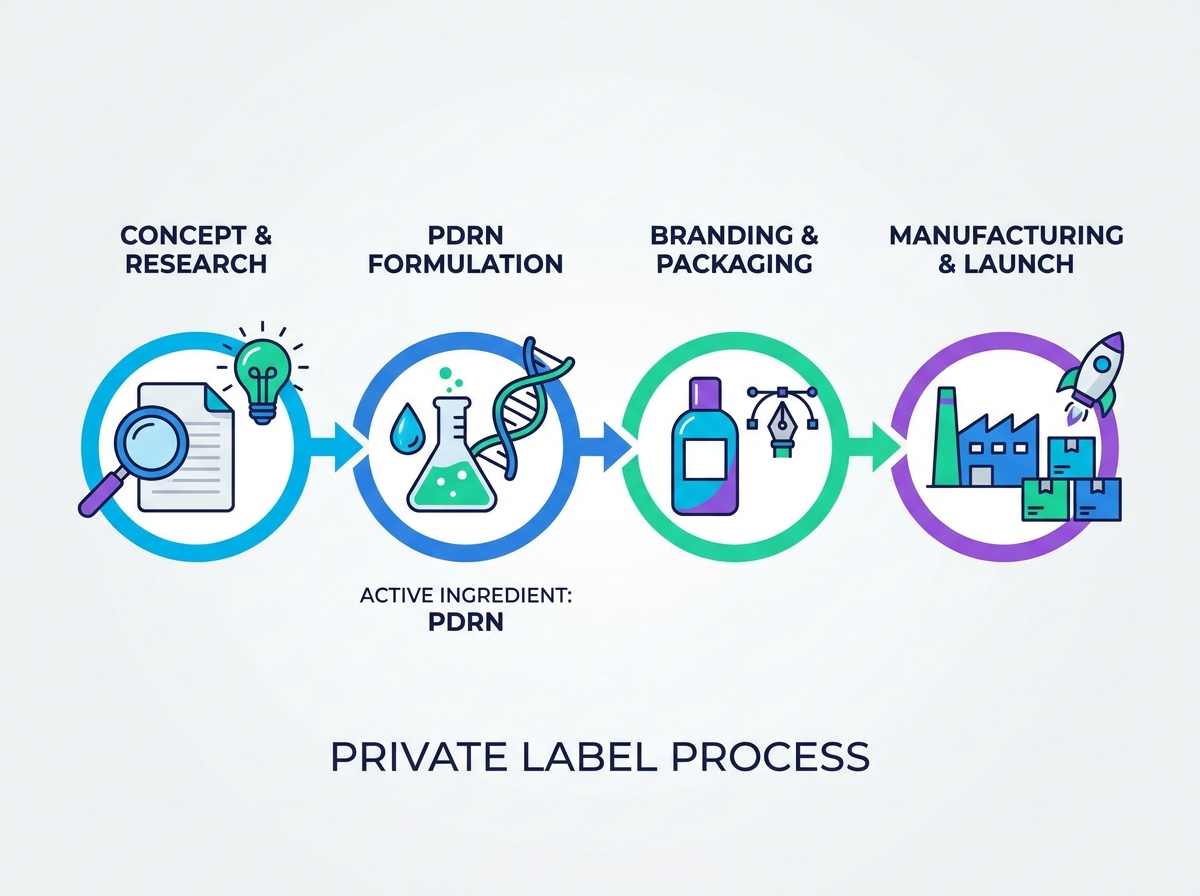
To successfully launch and market a regenerative skincare brand, you must deeply understand the biological mechanisms behind your core ingredient. Marketing fluff will not sell a clinical product; empirical science will.
Polydeoxyribonucleotide is a complex mixture of deoxyribonucleotides extracted primarily from the sperm DNA of salmon or trout. Scientifically, salmon DNA is utilized because its base composition closely mirrors human DNA structure. This remarkable similarity results in a high degree of biocompatibility. It absorbs easily into human cellular pathways with a remarkably low risk of immunogenic or allergic reactions.
When applied topically, this extract acts primarily as an agonist for the A2A purinergic receptor in the skin. This specific binding process triggers a cascade of biological responses. First, it accelerates the proliferation of fibroblasts. These are the specialized cells responsible for synthesizing fresh collagen and elastin. Concurrently, it promotes angiogenesis, which is the formation of new blood vessels. This improves microcirculation and nutrient delivery to damaged tissues. The clinical result is a profound reduction in localized inflammation and the visible thickening of the dermal layer.
A well-formulated regenerative product line appeals to several highly motivated demographics. Aging populations seek it to improve skin elasticity and combat cellular senescence. Post-procedure patients desperately need gentle, reparative skincare after harsh chemical peels or laser therapies. Furthermore, individuals battling acne scarring or compromised skin barriers actively look for non-irritating, restorative ingredients to accelerate tissue healing.
Developing a cosmetic formula from the ground up requires significant capital, highly specialized chemists, and years of rigorous stability testing. For most independent beauty brands, the private label route is a far more strategic and financially viable choice.
The traditional product development lifecycle is notoriously slow. It often takes anywhere from 18 to 36 months before a product hits the shelves. Formulators must source raw materials, conduct microbial challenge tests, and optimize textures. By choosing a private label strategy, this timeline compresses to roughly 3 to 6 months. You capitalize on the current regenerative trend while consumer interest is peaking.
Custom manufacturing typically requires immense minimum order quantities to offset the factory setup costs. Private labeling significantly lowers this barrier to entry. Many contract manufacturers offer minimums between 500 and 2,000 units for their existing formulas. This financial flexibility allows small businesses to test the market, gather real-world consumer feedback, and iterate without tying up excessive cash flow in dead inventory.
Biological extracts are notoriously complex. They require precise formulation parameters to remain active. Improper pH levels or incompatible emulsifiers can easily degrade the DNA fragments, rendering the product useless. When you leverage professional cosmetic contract manufacturing, you benefit directly from the laboratory's extensive prior experience. Their base formulas have already survived rigorous thermal stability, freeze-thaw, and preservative efficacy testing.
Before initiating contact with a factory, you must establish a clear, focused product architecture. A targeted, strategic launch is infinitely more effective than releasing a disjointed catalog of random products. Below is a practical selection matrix to help you structure your initial launch.
Product Category | Optimal Concentration | Primary Function | Recommended Packaging |
|---|---|---|---|
Professional Ampoules | High | Intense cellular repair, post-treatment healing | 2ml sterile glass vials |
Daily Repair Serum | Medium-High | Collagen synthesis, deep hydration, anti-aging | 30ml frosted glass airless pump |
Barrier Recovery Cream | Medium | Lipid matrix restoration, moisture retention | 50ml airless jar or aluminum tube |
Soothing Sheet Masks | Low-Medium | Immediate plumping, surface hydration, cooling | Multi-layer foil pouches |
A hero product is the cornerstone of your brand. It drives the most traffic and establishes your authority in the regenerative niche. Serums and ampoules are the most logical starting point for any clinical line. They offer the highest concentration of active ingredients and are formulated with smaller molecular weights for optimal epidermal penetration.
Picture a client leaving a medical spa after an intensive microneedling session. Their skin is flushed, compromised, and desperate for relief. A recovery cream serves as the perfect occlusive barrier here. It locks in the active ingredients while shielding the fragile epidermis from environmental stressors. Formulating a cream with a biomimetic lipid base ensures rapid barrier restoration.
The long-term success of your skincare line hinges entirely on the capabilities of your chosen manufacturing partner. Navigating this relationship requires an understanding of industry terminology and strict quality standards.
Original Equipment Manufacturer means you provide the exact, finalized formula, and the factory produces it at scale. Conversely, Original Design Manufacturer means the factory provides ready-made, fully tested formulas that you can slightly tweak and brand as your own. For most emerging brands, partnering with specialized OEM/ODM skincare manufacturers is the most efficient path. It combines the speed of private labeling with the flexibility of custom formulation.
Cosmetic manufacturing is strictly regulated. Safety can never be compromised. Ensure your prospective partner holds current ISO 22716 Cosmetics Good Manufacturing Practices certifications. If you plan to retail in the United States, the facility must be registered with the FDA under the MoCRA guidelines. For European distribution, they must be capable of assisting with CPnP documentation.
Because the core ingredient is an animal-derived extract, the sourcing methodology is absolutely critical. Inquire deeply about the manufacturer supply chain. Is the raw material ethically sourced as a byproduct of the fishing industry? More importantly, what does their purification process look like? The extraction must meticulously remove all proteins and peptides from the DNA to prevent allergic reactions in your end consumers.
Always demand physical samples before signing any production agreement. Evaluate the organoleptic properties carefully. A high-purity extract is completely odorless. It should never emit a fishy scent. Apply the product to compromised skin to objectively observe its soothing capabilities. Ensure it absorbs cleanly without leaving a tacky, uncomfortable residue.
To truly differentiate your line in a crowded market, relying on a single active is often insufficient. Creating a synergistic blend by incorporating complementary ingredients elevates the product efficacy and broadens its marketing appeal.
Collaborate closely with your custom skincare manufacturing solutions provider to weave supportive ingredients into the base formula.
Hyaluronic Acid Pairing: This is the gold standard pairing in regenerative beauty. While the DNA extract works on a cellular level to repair damaged tissue, Hyaluronic Acid acts as a powerful humectant. It draws moisture into the stratum corneum. Utilizing multi-molecular weight variants ensures both immediate surface hydration and deep tissue plumping.
Peptides and Ceramides: For ultimate anti-aging and structural repair, combining your core active with signal peptides creates a collagen-boosting powerhouse. Peptides signal the skin to produce more structural proteins. Meanwhile, ceramides reinforce the lipid matrix, effectively halting trans-epidermal water loss.
Niacinamide Integration: Niacinamide, also known as Vitamin B3, is a highly stable, versatile active that addresses uneven skin tone, enlarged pores, and inflammation. When paired together, the formulation transforms into a comprehensive treatment for fading post-acne scarring and accelerating overall tissue healing.
Today consumers scrutinize ingredient lists with a highly critical eye. To maximize your product marketability, ensure the formula adheres to modern clean beauty standards. Formulate entirely without parabens, phthalates, artificial colorants, and synthetic fragrances. Utilizing advanced, broad-spectrum preservative systems ensures consumer safety without triggering clean-beauty blacklists.
The physical presentation of your product is the very first touchpoint with the consumer. For a high-ticket item built around clinical science, the packaging must convey absolute authority, trust, and undeniable luxury.
Biological actives are notoriously sensitive to environmental degradation from light and oxygen exposure. Airless pump technology is strictly non-negotiable for high-end serums and creams. Imagine the unboxing experience featuring a heavy, frosted glass airless pump that feels cold to the touch. Beyond aesthetics, these containers utilize a vacuum mechanism that pushes the product upward. This entirely prevents air exposure, eliminates oxidation, drastically extends shelf life, and prevents bacterial cross-contamination from fingers.
Branding for regenerative skincare should lean heavily into clinical luxury. Avoid overly vibrant, chaotic colors or cluttered designs. Instead, utilize premium opaque acrylics or heavy-walled glass. Incorporate minimalist typography, ample white space, and clear percentage declarations. The final design should look entirely at home on a prestigious dermatologist shelf.
Regulatory compliance is a mandatory step that cannot be overlooked. Your labels must strictly adhere to the guidelines of your target market. All ingredients must be listed using official nomenclature. Additionally, clear usage instructions, standard cosmetic warnings, and accurate net weight metrics must be prominently displayed.
Even the most scientifically advanced formulation will gather dust without a strategic, aggressive marketing plan. Because the underlying science is complex, your marketing must expertly bridge the gap between high-level biology and tangible consumer benefits.
Consumers need to understand exactly what they are putting on their faces. Create content that demystifies the biological origins of your product. Utilize visually engaging infographics, detailed blog posts, and short-form video platforms. Break down the intimidating science of cellular regeneration into easily digestible, highly visual, and entertaining content.
In the realm of clinical skincare, seeing is truly believing. The persuasive power of visual evidence cannot be overstated. Utilize clinical trial data to legally back up your claims. Gather rigorous customer testimonials and actively encourage user-generated content to build an authentic community of trust.
Build a robust, visually stunning e-commerce presence to drive retail sales directly to end-users. Deploy targeted social media advertising and SEO-driven educational content. Simultaneously, pitch your private label line directly to local dermatologists, medical spas, and licensed estheticians. These professionals can seamlessly retail your products to their patients as essential post-treatment care, providing an incredibly lucrative wholesale revenue stream.
The regenerative skincare market offers massive and sustainable growth potential for forward-thinking entrepreneurs. By choosing the private label route, you maximize your operational efficiency, drastically reduce your financial risk, and accelerate your speed to market.
Developing a premium, clinical-grade skincare line is highly accessible when you utilize the right operational framework. You simply need a trusted manufacturing partner to succeed. Start by thoroughly researching your target demographic and defining a clear product vision. If you are ready to initiate production and secure high-quality formulas, explore the comprehensive catalog at Aixin Cosmetics to find the exact formulations and packaging solutions tailored to your brand vision. The market is hungry for innovation. Now is the time to deliver.
No, the active ingredient is extracted from the DNA of salmon or trout, making it an animal-derived component and therefore not vegan. However, it is generally considered cruelty-free. The extraction process frequently utilizes biological byproducts from the established commercial fishing industry. Brand owners should always verify exact ethical sourcing methods with their manufacturing partners.
Initial investment costs vary widely depending on the chosen manufacturer, formulation complexity, packaging quality, and specific minimum order quantities. Generally, a small-batch, lean initial launch can range anywhere from $2,000 to $10,000. This budget typically covers product formulation, custom packaging, and your initial inventory run.
Yes, you can absolutely sell these products on Amazon. However, you must ensure that your manufacturing partner adheres strictly to all regional safety regulations. You will need proper brand registry documentation, accurate ingredient compliance, and comprehensive safety data sheets to meet the strict health and beauty category gating requirements.
Minimum requirements depend heavily on the specific facility and the level of customization required. They can range from as low as 500 units for basic, pre-existing white-label products placed in standard packaging. Conversely, for fully customized formulations with bespoke, branded packaging, expect minimums to range between 3,000 and 5,000 units.
Generally, yes. It is highly celebrated in the dermatological community for its incredible biocompatibility with human skin. Its primary biological functions revolve around soothing deep inflammation and regenerating cellular tissue. This makes it exceptionally well-suited for sensitive, aging, compromised, and acne-scarred skin profiles. Recommending a standard patch test for new users is always best practice.
Because it works at a cellular level to stimulate fibroblast production, results are not overnight. Most clinical observations report a visible reduction in redness and inflammation within the first week of consistent use. For structural improvements like increased skin elasticity, wrinkle reduction, and scar fading, consumers typically need to apply the product daily for 4 to 8 weeks.
Yes, it is highly complementary to other powerful active ingredients. Because its primary function is to soothe inflammation and repair the skin barrier, it actually helps mitigate the irritation commonly caused by strong retinoids or high-concentration ascorbic acid. Applying a regenerative serum after a chemical exfoliant or retinol can significantly reduce epidermal stress while boosting overall collagen synthesis.


