


Views: 0 Author: Site Editor Publish Time: 2026-11-06 Origin: Site


Table of Contents
Navigating the modern cosmetic chemistry landscape requires moving far beyond basic hydration. As consumers become increasingly educated about dermal health and cellular aging, the demand has shifted toward scientifically backed active ingredients. People want tangible, structural results. From a clinical formulation standpoint, observing dynamic expression lines transitioning into permanent static folds is a clear signal. This is exactly where the nuanced science of targeted peptide treatments becomes essential.
Recent cosmetic industry data indicates a massive pivot toward biomimetic formulations. Dermatologists and formulation chemists are noting a distinct "retinoid fatigue" among consumers dealing with chronically compromised skin barriers. Consequently, the market is shifting toward synergistic peptide stacking. This advanced approach delivers clinical-grade structural repair without the chronic inflammation associated with traditional, aggressive exfoliants. Among the myriad of raw materials available, peptides have emerged as the absolute cornerstone of non-invasive skin rejuvenation.
Two of the most highly discussed and sought-after compounds in advanced laboratories today are GHK-Cu, widely known as Copper Peptides, and SNAP-8. While both are celebrated for their profound anti-aging capabilities, they perform fundamentally different physiological functions. One acts as a diligent architect, physically rebuilding the structural matrix of the skin. The other serves as a gentle neuromediator, relaxing the repetitive muscle movements that cause surface creasing. In this comprehensive technical breakdown, we will explore the intricate chemical differences between these two powerhouse ingredients. Furthermore, we will examine how integrating an advanced anti-wrinkle peptide cream that stabilizes both compounds might be the ultimate strategy for comprehensive facial rejuvenation.
Distinct Biological Mechanisms: GHK-Cu functions as a highly effective carrier peptide. It delivers essential copper ions directly to fibroblasts, actively promoting collagen synthesis and tissue healing. Conversely, SNAP-8 operates as a neurotransmitter-inhibiting neuropeptide. It gently limits localized muscle contractions to soften expression lines.
Targeted Structural Zones: GHK-Cu is scientifically optimized for improving overall dermal firmness, structural elasticity, and repairing compromised lipid barriers. SNAP-8 is specifically targeted at dynamic mechanical wrinkles, such as crow's feet and horizontal forehead bands.
Chemical Sensitivities: GHK-Cu is notoriously fragile in low-pH environments. It will rapidly degrade and potentially cause oxidative stress if mixed with direct L-Ascorbic Acid or strong chemical exfoliants. SNAP-8 exhibits far greater chemical stability, making it highly versatile in complex emulsions.
Formulation Synergy: Modern cosmetic engineering allows advanced products to safely combine both peptides. This dual approach targets structural chronological aging and mechanical expression-based aging simultaneously.
To fully grasp the dynamic between these two active ingredients, we must first establish a foundational understanding of peptide molecular biology. Rather than relying on ingredients that force cell turnover through irritation, formulators are utilizing peptides to communicate directly with the cellular matrix.
In biological terms, peptides are short chains of amino acids linked together by peptide bonds. You can think of them as the fundamental building blocks of critical structural proteins in the human body, including collagen, elastin, and keratin. When these proteins degrade due to UV exposure or intrinsic aging, the skin loses its underlying architectural integrity. This inevitably leads to sagging, thinning, and the formation of deep-set wrinkles.
Whole protein molecules like topical collagen are far too large—often exceeding 300,000 Daltons—to penetrate the stratum corneum. Peptides, however, boast a much lower molecular weight, typically under 1,000 Daltons. This allows them to successfully bypass the lipid barrier. Once absorbed into the deeper dermal layers, they bind to specific cellular receptors. They signal the fibroblasts to perform targeted functions, such as initiating the wound-healing cascade or ramping up the production of fresh collagen fibers.
Not all peptides are created equal. The cosmetic industry categorizes them based on their specific mechanisms of action. Understanding these distinct categories is essential for evaluating product efficacy:
Carrier Peptides: These molecules bind to and deliver vital trace minerals deep into the epidermis and dermis. GHK-Cu stands as the most prominent and extensively researched example of a carrier peptide.
Neurotransmitter Inhibitor Peptides: Often referred to as neuropeptides, these specialized compounds are designed to intercept the chemical signals sent from nerve endings to facial muscles. SNAP-8 falls squarely into this category.
Signal Peptides: These stimulate the skin to produce more structural proteins. They essentially trick the body into thinking collagen has broken down and requires immediate replacement.
Enzyme Inhibitor Peptides: These slow down the natural degradation of existing collagen by inhibiting destructive enzymes known as matrix metalloproteinases.
GHK-Cu has garnered immense attention in clinical dermatology for its profound ability to remodel the extracellular matrix. When you dispense a pure copper peptide serum, you immediately notice its distinct, natural blue tint. This is not a synthetic dye; it is the visual hallmark of active copper ions suspended in the formula.
GHK-Cu, or Glycyl-L-histidyl-L-lysine bound to a copper ion, is a naturally occurring complex found abundantly in human blood plasma. Discovered in the 1970s, it was initially identified for its remarkable ability to stimulate tissue repair and promote stem cell survival. Unfortunately, the natural concentration of GHK-Cu in the human body drops precipitously as we age. It plummets from about 200 nanograms per milliliter at age 20 to a mere 80 nanograms by age 60.
When engineered into topical skincare, GHK-Cu acts as a highly efficient delivery system. It escorts vital copper ions deep into the dermal layers. Once there, the copper acts as an essential cofactor for lysyl oxidase. This specific enzyme is absolutely critical for the cross-linking and maturation of collagen and elastin fibers. Furthermore, GHK-Cu modulates the activity of metalloproteinases. It helps the skin clear out damaged, fragmented collagen while simultaneously stimulating the outgrowth of new blood vessels to improve localized nutrient delivery.
The application of stabilized GHK-Cu yields a wide array of structural benefits for environmentally stressed skin. Consistent use leads to measurable improvements in several areas:
Accelerated Barrier Healing: It rapidly speeds up skin repair. This makes it highly beneficial for compromised barriers, chronic redness, or post-procedure recovery after laser treatments.
Increased Dermal Density: By upregulating collagen types I and III, it actively reverses the papery thinning of the skin associated with chronological aging.
Enhanced Tensile Strength: The structural cross-linking of proteins significantly improves skin bounce, reducing overall facial sagging and jowl formation.
Photodamage Reversal: It possesses potent anti-inflammatory properties that help neutralize oxidative stress and fade hyperpigmentation caused by prolonged UV exposure.
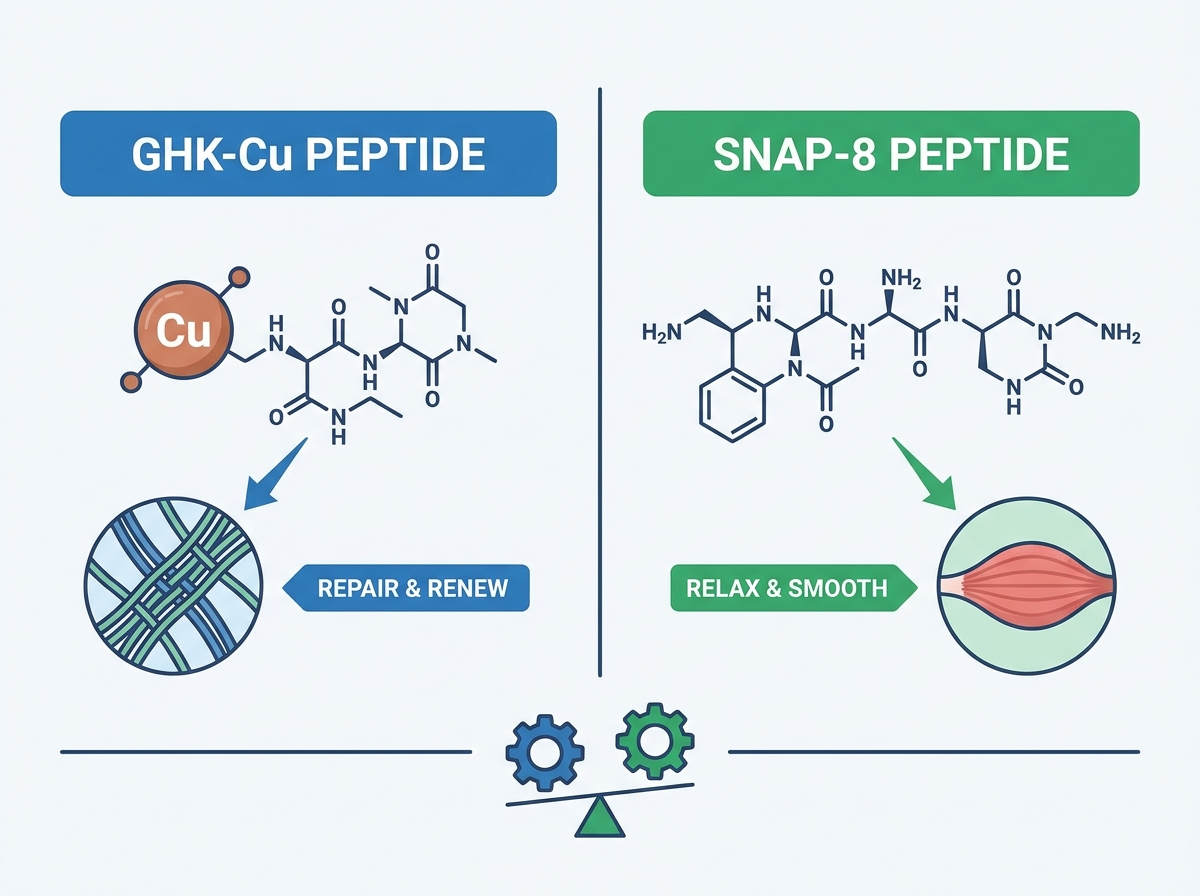
While GHK-Cu focuses heavily on rebuilding the skin from the inside out, SNAP-8 approaches anti-aging from a highly mechanical angle. It is specifically engineered to address the repetitive physical movements that cause the skin to permanently crease over time.
SNAP-8, scientifically listed as Acetyl Octapeptide-3, is an advanced elongation of the famous Argireline molecule. It was meticulously developed by cosmetic scientists to serve as a topical, non-invasive alternative to clinical neurotoxin injections.
To truly understand how SNAP-8 works, we must look at the SNARE complex. Every time your brain tells your face to smile or frown, a neurotransmitter called acetylcholine is released into the muscle, triggering a contraction. The SNARE complex is a specific group of proteins required for this chemical release to occur successfully. SNAP-8 is designed to mimic the N-terminal end of the SNAP-25 protein. It competes for a position within this complex. By slightly destabilizing the SNARE structure, SNAP-8 limits the efficient release of acetylcholine. Consequently, the result is a mild, localized attenuation of muscle contractions. The underlying muscle remains relaxed, effectively preventing the overlying skin from folding.
Because of its highly specific mechanism of action, SNAP-8 is not typically utilized for overall facial volume loss. Instead, its benefits are intensely localized to dynamic wrinkles.
Upper Facial Zones: It is exceptionally effective for reducing the depth of horizontal forehead lines and the stubborn glabellar lines that form between the eyebrows.
Periorbital Wrinkles: When expertly formulated into eye treatments, it softens the radiating crow's feet that extend from the corners of the eyes during smiling or squinting.
Preventative Maintenance: For younger demographics, SNAP-8 is frequently deployed as a preventative measure. It actively delays the onset of permanent static wrinkles before the dermal matrix is permanently fractured.
For consumers and formulators alike, understanding the nuanced differences between these two peptides is vital. These ingredients are not interchangeable. They serve distinctly different physiological purposes and require entirely different chemical environments to remain stable upon application.
The fundamental distinction lies in their core approach. GHK-Cu acts as the master architect. It physically reconstructs the dermal matrix, increases tissue density, and repairs cellular damage at a foundational level. In contrast, SNAP-8 acts as the mediator. It does not synthesize collagen directly. Rather, it calms the neuromuscular signals, relaxing the facial muscles to halt the mechanical folding of the skin.
From a cosmetic chemistry standpoint, these peptides behave very differently. This is where many poorly formulated products fail.
GHK-Cu is notoriously difficult to stabilize. It requires a very specific, neutral pH environment, typically between 5.5 and 7.0, to remain biologically active. If the surrounding formulation is too acidic, the vital copper ion will violently detach from the peptide chain. This renders the active ingredient completely useless. Worse, free copper ions can create pro-oxidant free radicals that actively damage the skin. Furthermore, GHK-Cu conflicts heavily with strong chelating agents commonly used in cosmetics.
SNAP-8 is comparatively robust. It remains stable across a wider variety of water-based serums and emulsions. It is generally far less reactive when layered with other common skincare actives, making it a highly versatile addition to anti-aging routines.
Formulation Feature | GHK-Cu (Copper Peptide) | SNAP-8 (Acetyl Octapeptide-3) |
|---|---|---|
Peptide Category | Carrier Peptide (Trace Mineral Delivery) | Neurotransmitter Inhibitor (Neuropeptide) |
Primary Mechanism | Delivers copper to stimulate lysyl oxidase and collagen synthesis. | Destabilizes SNARE complex to attenuate muscle contractions. |
Optimal Target Profile | Sagging, thinning skin, impaired barrier, loss of overall elasticity. | Dynamic expression lines, forehead bands, crow's feet. |
pH Stability Range | Strictly 5.5 - 7.0 (Highly sensitive to acid degradation). | Broadly stable across standard cosmetic pH ranges (4.0 - 7.0). |
Clinical Timeline | Gradual structural thickening over 8 to 12 weeks. | Visible softening of expression lines within 2 to 4 weeks. |
Given their distinct and complementary mechanisms, combining these two ingredients creates a powerful synergistic effect. This approach addresses facial aging from 360 degrees. While SNAP-8 works immediately to stop the skin from continuously folding, GHK-Cu works diligently in the background. It actively rebuilds the broken collagen fibers within those very same creases. By halting the mechanical damage while simultaneously boosting structural repair, users achieve significantly better clinical outcomes than using either peptide in isolation.
While it is technically possible to purchase separate serums and layer them, this introduces a high risk of user-end chemistry errors. Mismatched pH levels between different brands can easily destroy the copper peptides. A much safer, highly effective strategy is to invest in an expertly engineered GHK-Cu and SNAP-8 formulation.
Premium products, such as those utilizing an advanced lipid-based delivery system, are meticulously balanced in a controlled laboratory setting. By maintaining a strict pH matrix around 6.0, formulators ensure that both the sensitive copper ions of GHK-Cu and the neuropeptide structure of SNAP-8 remain perfectly suspended. This guarantees maximum efficacy without the risk of rapid degradation upon contact with the skin.
Understanding formulation chemistry is just as critical as buying quality ingredients. Improper combining can lead to rapid chemical breakdown, rendering expensive products completely inert.
The most significant formulation challenge lies with GHK-Cu. As previously established, copper peptides are incredibly fragile. When GHK-Cu is introduced to strong exfoliating acids, such as glycolic acid, lactic acid, or salicylic acid, the delicate peptide bond is severed. Applying a copper peptide serum immediately after a low-pH acid toner will destroy the peptide's regenerative capabilities entirely.
Similarly, pure L-Ascorbic Acid presents a severe redox conflict. Mixing copper with ascorbic acid triggers an immediate oxidation-reduction reaction. The copper ions oxidize the Vitamin C, neutralizing both ingredients. If you utilize these actives, you must alternate them strategically. Apply your acidic Vitamin C or chemical exfoliants in the morning, and reserve your restorative peptide creams for your nighttime cellular repair routine.
Selecting the correct peptide formulation depends entirely on your specific dermatological profile and aesthetic goals. To ensure you invest in a product that delivers targeted results, consider the following engineering criteria.
You should prioritize formulas heavily concentrated in GHK-Cu if you are experiencing noticeable structural degradation. It is the ideal choice for individuals dealing with a general loss of facial volume, chronic dullness, or a compromised skin barrier resulting from over-exfoliation. It is essential for treating persistent photodamage and improving overall skin density.
SNAP-8 should be your primary focus if your main concerns revolve around localized expression lines. It is highly recommended for those actively seeking a topical, non-invasive alternative to smooth out horizontal forehead wrinkles and deep crow's feet before they become permanently etched into the dermis.
Skin aging is rarely a one-dimensional process. Most individuals simultaneously experience both structural volume loss and repeated muscle contraction wear. For comprehensive long-term management, opting for a dual-action GHK-Cu and SNAP-8 formulation is unequivocally the most efficient choice. Look for creams packaged in airless pumps to prevent oxygen exposure, and ensure the ingredient deck includes synergistic humectants like hyaluronic acid and barrier-repairing ceramides.
The discussion surrounding these two ingredients is not about determining which peptide is objectively superior. Rather, it highlights how modern cosmetic science has successfully isolated specific compounds to treat highly specific mechanisms of aging. GHK-Cu acts as the master builder, meticulously rebuilding the skin's structural integrity and boosting collagen density. Meanwhile, SNAP-8 acts as the mediator, calming the muscular contractions that lead to visible, deep-set creasing.
Both peptides serve unique, highly valuable purposes in dermatological care. By understanding their distinct roles, respecting their strict formulation pH sensitivities, and embracing the power of synergy, you can optimize your skincare architecture. Upgrade your daily regimen today by integrating a high-quality, expertly crafted GHK-Cu & SNAP-8 Advanced Anti-Wrinkle Peptide Cream, and unlock a truly comprehensive, scientifically validated approach to youthful, resilient skin.
Understanding the biological timeline of skincare ingredients is crucial for managing expectations. Because they operate through entirely different mechanisms, their visible results manifest at different rates. SNAP-8 works by modulating neurotransmitter release, meaning its effects on muscle tension can be observed relatively quickly. With consistent application, users often notice a subtle smoothing effect on dynamic expression lines in as little as two to four weeks. In contrast, GHK-Cu requires a significantly longer commitment. Rebuilding a degraded dermal matrix is a slow biological process. Clinical observations suggest that GHK-Cu requires a minimum of eight to twelve weeks of consistent use to visibly improve skin density, elasticity, and overall structural firmness.
In professional cosmetic chemistry, more is not always better. The optimal concentration for topical GHK-Cu typically ranges between 1% and 2%. At this precise level, the peptide effectively stimulates collagen production and tissue repair without overwhelming the cellular receptors. Applying excessively high concentrations can lead to a well-documented phenomenon known as the "copper uglies." An over-accumulation of copper can trigger an overproduction of metalloproteinase enzymes that break down healthy collagen, leading to temporary skin dullness and a crepey appearance. Always rely on expertly balanced, lab-tested formulations rather than raw DIY mixing.
No, SNAP-8 does not cause muscle atrophy or facial sagging. This is a common misconception stemming from comparisons to injectable neurotoxins. Injectables completely paralyze the muscle by blocking the nerve signal entirely. SNAP-8, applied topically, only mildly attenuates the signal by competing within the SNARE complex. It gently relaxes the muscle tension without freezing it or causing the underlying tissue to degrade from lack of use. It is a completely safe, non-invasive modulator for daily use.
Yes, you can incorporate retinol into a routine containing these peptides, but it must be done with strategic caution to prevent compromising your delicate skin barrier. SNAP-8 is highly stable and does not typically conflict with retinol. GHK-Cu, however, is highly active. While it does not chemically neutralize retinol in the same way Ascorbic Acid does, applying both potent actives simultaneously can overwhelm the skin, leading to severe dryness and flaking. Formulation engineers generally recommend separating these ingredients by time of day. Apply your peptide formulations in the morning to support hydration and structural defense, and reserve your retinol application for your nighttime routine to facilitate overnight cellular turnover.
The comparison between topical neuropeptides and injectable neurotoxins requires realistic expectations. Clinical injectables are placed directly into the facial muscle, completely severing the communication pathway between the nerve and the muscle for several months. SNAP-8, applied topically, cannot penetrate deeply enough to reach the muscle fiber itself. Instead, it works within the skin layers to limit the release of neurotransmitters. While clinical studies indicate that SNAP-8 can reduce the depth of wrinkles caused by facial muscle contractions by up to 34% over a month of use, it is not a replacement for the freezing effect of an injection. It is an exceptional, non-invasive alternative for softening fine lines and prolonging the longevity of actual injectable treatments.


